

What Makeup Used For Film Sets
The developments in movie make-upwards in the early twentieth century were on a scale like to the changes that took identify in nineteenth-century stage brand-up after electric lighting was introduced into theatres. The motility picture industry would later develop brand-up specifically for film only early screen players had to work with what was on hand. For most part this meant stage greasepaint and powder.
See also: Greasepaint
From stage to screen
Stage performers who came to work in early silent films knew how to apply blackface and powder but soon realised that the brand-up techniques they used for the stage were by and large unsuitable for the screen.
No stage artiste, no matter what his or her reputation or experience, tin can enter the silent drama for the kickoff fourth dimension with an all-comprehensive knowledge of the fine art. They must learn the limitations of the moving picture stage; they must learn to depend solely upon artistic action and not on creative lines; they must cultivate a alter in the art of make-up; and there are many other petty details essential for success that must be absorbed by the stage artiste who starts to work in the silent drama.
(Dangerfield & Howard, 1921, pp. 91-92)
Early motion picture stocks
A big part of the trouble with using make-up for the screen was the moving picture stock. Until the 1920s, virtually black and white motion pictures were fabricated with blueish-sensitive or orthochromatic film. Blue-sensitive motion picture was sensitive to the blueish-violet cease of the visible spectrum but insensitive to the yellowish-red finish, which meant that information technology registered reds and yellows as black and light dejection every bit white. Orthochromatic film was very sensitive to violet light, markedly sensitive to bluish and ultra-violet, much less sensitive to dark-green and yellow light, and insensitive to red and so had like problems when it came to registering colours.
Labelling film stocks as blue-sensitive or orthochromatic can be problematic. For example, Eastman Standard Negative movie stock, widely used in Hollywood, has been described as orthochromatic but may in fact be more than correctly described every bit blueish-sensitive as it appears to take been completely insensitive to the yellow end of the spectrum.
The problems created by these early on picture stocks included blonde pilus photographing too dark, light-bluish eyes photographing virtually white, and cloudy skies filming flat white. Moreover, every bit the full spectrum was not captured, grey-calibration tonal differences were express, resulting in images with a higher dissimilarity than was visible with the naked centre. This meant that noticeable demarcations (lines) would sometimes appear on flick where the naked eye only saw a gradual alloy.
A skilled cameramen could ameliorate some of these issues with filters, by controlling the lighting, and by carefully selecting the locations and the colours that were to be filmed. Early on cinematographers got very adept at estimating what tone of grey a particular colour would look similar when filmed, a task made easier when they realised that viewing a scene through a blueish lens gave them a good tonal approximation (Bordwell, Staiger & Thompson, 1985, p. 283).
Skin tones
Blue-sensitive and orthochromatic moving picture renders red as black, so unmade-upwardly faces looked darker on the screen than they were in reality and whatever blotchiness in the complexion made faces look dirty. Many early flick actors, peculiarly those that came from the stage, responded to these issues by covering their face with heavy make-upwards, giving them a look that belonged more than on a mortician's slab than a motion-picture show set. The do was so common that information technology became near a convention in early silent films to make the faces of heroes and heroines white while the remainder of the cast, who were less fabricated-up, looked darker.
Phase brand-up is out of the question in the move movie studio for the pinks and yellows so commonly used in getting mankind tints are distorted in colour value in the film. Any tint containing red is recorded on the film at least in three shades darker than the original color, for this colour has practically no actinic value. As the areas covered by the red undergo no changes due to the reduction of argent in the emulsion, the positive is printed in black nether these transparent spots in the negative.
(Rathbun, 1914, p. 64)
Every bit move pictures became more sophisticated through the 1910s, directors began to insist on more a natural look and the mask-like faces of earlier films disappeared. This had a downside. The use of greasepaint liners and crêpe pilus – used to create character or historic period on the stage – looked less realistic in shut-ups, so directors began to select individuals for parts on the basis of their natural appearance, a practice that led to more type casting. The greasepaint liners and crêpe hair were still essential for special effects – such every bit when scars or wrinkles were required or when actors had to historic period – only they had to be used more than discretely.
Lining should not be resorted to except in cases where the character of the part absolutely requires it. Lines should be made with dark red or dark-brown and very carefully composite. Directors should take pains to select their characters according to type whenever possible and non require people to make-upward out of their type unless in cases of increasing age, or effects of affliction, etc., chosen for past the scenario.
(Gregory, 1920, p. 316)
Lighting
A 2d problem was lighting. To become sufficient low-cal and keep costs down, early silent films were filmed in daylight, either on open up stages or on location. As the movie industry adult and became more prosperous, artificial lights were introduced – first to supplement the natural light and so to replace it altogether. This freed filming from the vagaries of conditions and, in the long run, gave cinematographers greater command over how their movies looked on screen.
Early moving-picture show studios did not utilise incandescent lights of the sort used on theatre stages as they had a low actinicity – the proportion of the light which is captured on the film stock – on blueish-sensitive or orthochromatic moving picture. Instead they relied on mercury-vapour and/or carbon-arc lights. The Cooper-Hewitt mercury-vapour lamps used in American film studios produced a soft, blueish-green low-cal that was platonic for film only sensitive to the blue end of the spectrum but made everything looked unnatural on the gear up. Carbon-arc lamps produced a brighter, whiter lite but the light was harder and the lamps were noisy and spluttery. Early open up arcs besides produced arc-light dust which irritated the role player'due south eyes when information technology got into them. Later closed arc lamps – oft called 'Klieglights' in the Us later on the Kliegl company, a major supplier – did not have this trouble. However, they yet acquired eye issues due to the unshielded ultra-violet light they produced – the so-called 'Klieg eye' (actinic conjunctivitis).
Every profession has its disagreeable duties, and 1 of ours is to work under the studio lights. Every actress dreads them, for they are simply cruel to the eyes, and to work within a few anxiety of eight or ten ghastly, hissing, flaming arcs will unnerve the strongest of united states of america. The red rays are entirely absent in these awful things, the consequence being that when they are used, everything in the scene is bathed in a sickly, blue greenish. Faces announced cadaverous grayness and the red of i's lips looks purple. The actors appear like uncanny corpses suddenly come to life. The light is and so dreadful to the eyes that the least upshot is a splitting headache, and the worst, the necessity of seeking the solace of an oculist or of wearing amber glasses for several days.
(Wagner, 1918, pp. 93-94)
Bogus lighting created problems for early screen actors but information technology as well opened up new possibilities. Equally bogus lighting improved and the techniques for using information technology got more sophisticated, it become clear that it was at least as, if not more than important than make-up in determining the way actors looked on the screen.
Other issues
In addition to the challenges created past lighting and movie stocks, screen stars had to contend with ii other developments particular to photography; the previously mentioned 'close-upwardly' which revealed more detail of an role player'south face than could ever be seen from the stage; and that intangible quality, the 'camera face' which could decide whether they got into movies in the outset place.
A camera face up, or the gift of photographing pleasingly, is a bully asset to a person seeking an opening in photoplay interim. Many a well-known "star" of today entered in the industry without previous experience because he or she possessed a photographic camera face. As ofttimes equally non such persons were singled out from amongst a crowd of "extras," granted a tryout before the camera, and then taken in hand afterward proving adept photographic types.
(Lescarboura, 1921, p. 44)
Unlike stage make-up – which was primarily used to strengthen facial features washed out under strong lighting – the main objective of early film make-up was to hide peel imperfections, either those that were clearly visible or the ones only apparent through the photographic camera. Unless an actor had an absolutely flawless complexion, make-upwards was needed to even out their skin tone. Withal, in shut-ups this had to exist achieved without using heavy make-upwardly.
Either heavy make-up or the close-upwardly must go, and as I believe the close-up is due to remain an essential characteristic in effective motion picture photography, the players must employ their make-upward with an unusual caste of care. One really should be a portrait painter to obtain the right event.
(Dangerfield & Howard, 1921, p. 48)
A 2nd simply every bit of import function of early film make-up was to make the best of an thespian's facial features. Although an interesting 'camera face' was non essential for becoming a screen thespian – acting ability was besides important – it was highly desirable. When make-up specialists, like Max Cistron and the Westmores, began to get involved with the American film studios in the 1920s, they transformed many famous faces to brand them more than pleasing when filmed.
Run into also: Max Gene and the Firm of Westmore
Greasepaint and pulverisation
In the early on days of motion picture, some screen stars, especially men, refused to employ any form of make-upwards simply most were eventually persuaded to practice and then. Individuals with a expert complexion could get away with using a little cold foam covered with powder but otherwise traditional greasepaint was needed. As the demands of the screen became ameliorate understood, the greasepaint was applied more thinly and worked well into the skin and then that it looked as natural equally possible before pulverisation was applied.
The ground of every make-up is a grease paint, a sparse coat of which is rubbed well into the skin. … The grease paint, if put on properly, will give the skin a perfectly smooth surface of a shade slightly lighter than the grease appears in the jar. If your skin does not announced normal, except in matter of colour, your grease has non been rubbed in sufficiently. Your pores should show as clearly as they unremarkably do earlier you are fix to go beyond the grease paint.
(Hatton, 1922, p. 22)
Actors had to blend the greasepaint and pulverization to ensure that it covered the area behind the ears and the neck, and to avert the demarcation lines and blotchiness that resulted from the greater contrast and limited spectrum sensitivity of blue-sensitive picture show.
Blending powders they are chosen, and blending powders they should be. The pulverization covers the entire face up and is composite smoothly with the base by the irksome and rather tedious process of patting information technology on gently but firmly with a large pulverization puff. Selection of colour in blending pulverization and intendance in applying it is quite equally important every bit any other function of the make-upwardly.
(Hatton, 1922, p. 23)
The tonal shades of the blackface and pulverisation used by movie actors depended on the filming conditions, the character they were playing and individual preferences. Women mostly selected a lighter pare tone than men, which reflected the social norm for lighter skin in the days before suntanning became the vogue. Many actresses felt light tones also made them look younger; needless to say some overdid it.
Some actresses think that the lighter they can brand themselves the more youthful they appear whereas they merely succeed in making themselves await similar billiard assurance. A good natural flesh tint with a powdering over of flesh tinted powder to impale the gloss of grease paint cannot be improved upon.
(Gregory, 1920, p. 318)
Many screen stars believed that greasepaint restricted their facial expressions and this seems to have been one reason why some only used powder or switched to a cream greasepaint such as Max Factor's Supreme Greasepaint or Leichner's Greasepaint in Tubes. These could be applied thinly and felt more flexible on the skin.
Colour and tone
Early screen actors and actresses unremarkably did their own make-up, and so they had to know how they looked when photographed and how to employ it for the best result. They too had to be able to estimate the tonality of their make-up colours – to know how color would wait when converted to the blackness, whites and greys. Like the cinematographers they could likewise use blue drinking glass to go an approximation of how their brand-up would film.
In initial attempts information technology may help first to make up the part as though for the regular stage in ordinary tinted grease paints. Then view the event in a mirror holding a square of vivid blue glass to the eyes. This will give the effect as it would be in monochrome. Yous will then at once see how far to alter your methods and then as to obtain the same issue in black and white for the moving moving-picture show camera. You lot can go blue drinking glass from any glazier.
('The kinematograph and lantern weekly,' October 31, 1912, p. 133)
Selecting make-up on its grey-scale tone, non its color, was an art non everyone became good at it. Nevertheless, with the assistance of the cameraman/cinematographer, some photographic tests and practice, nigh players could develop a suitable routine. Given the importance of the fashion they looked on screen, for some it became an obsession.
There was a lot of disagreement amongst players on how to make-up for the silent screen. Pink, more or less mankind-coloured make-up was usually used but there was too a widespread belief that a suitable complexion could be only be produced by using yellows. A number of artists recommended using a Leichner No. 5 greasepaint or similar, sometimes used for a 'Chinese' make-up on the stage.
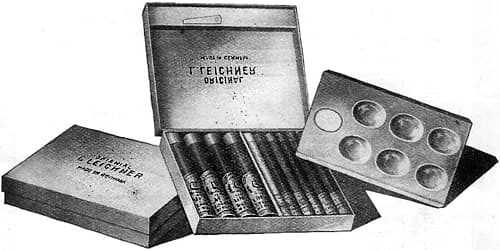
Above: 1926 Leichner Movie theater Set in a can case with mixing pallet containing 4 standard sticks and vi liners. Leichner recommended a number of yellows, dark-green and violet greasepaints for use when filming. These included No. v Chinese, the main shade used; No. thirteen Blood-red Brown for shading the hollows of the eye; No. 336 Dark-green III to brand full faces lean; No. 337 Lilac (light, night, or extra night, for making stout, use light pulverization); and No. 338 Greenish (for making faces lean, use xanthous powder).
Besides see the Leichner booklet: Artists Catalogue (1926)
In most all cases the face is first thoroughly whitened and and then tinted with yellow so that any subsequent color that may exist applied will stand out in bold relief, and too for the reason that the face up will appear white instead of grey, as would be the example with the natural color of the complexion. The lips and the expanse surrounding the eyes are tinted with a color having a bluish cast such as heliotrope or mauve. When seen in the sunlight, the make up of the move picture actor presents a near ghastly appearance.
(Rathbun, 1914, p. 64)
The powders used for picture makeup are specially mixed for the purpose. They are yellowish in color. Do non have others. Theatrical powders are not permissible. The powders are known as Special Motion picture No. i and No. 2, and are used for all grease numbers except cork for negro makeup, when a powder is not necessary.
(Leslie, 1916, p. 176)
The universal colour for men is a yellowish grease-paint with a slight bear upon of pink underneath. Blondes should be a little more yellowish than brunettes. Ladies should apply a light pinkish or yellow with pink powder. The greasepaint must cover all claret corpuscles and freckles, which, if not properly covered, will photo black.
(Bernique, 1916, p. 24)
If you have never had a "try-out" utilise a light xanthous grease paint, such equally Stein's No. 27, or the Leichner Light Yellow that comes in a porcelain box, as a foundation. It is very difficult to tell how a peel volition look in a photograph; when I say "photograph" I mean pictures made in the glare of Klieg lights. Some skins reflect low-cal more than others and therefore take lighter. Practical experience only will determine what is all-time for you. A light shade of yellowish will photograph lighter than a grease paint containing pink, unless the latter has been applied to an extremely off-white skin. Some skins reflect then much lite that a heavier shade of grease paint is used in order that the face may be toned down to friction match others in the scene.
(Chalmers, 1925, p. 127)
Green or blue make-upward was as well suggested due to its high actinicity with blue-sensitive and othochromatic film. It may also have been easier to reconcile information technology under the blueish-green low-cal of the mercury-vapour lamps.
The player with a fair complexion seldom uses grease-paint at all. He finds that cold-foam with a dash of light-brown powder screens effectively.
The thespian, however, possessing what I might term a medium complexion, uses either a yellow or nighttime-blue grease-paint later on outset applying cold-cream to the confront, only, in order to foreclose his face screening like a brawl of grease, he covers it with a light-brown pulverisation.(Dench, 1917, p. 278)
All the same, the utilize of these 'unnatural' colours had their critics.
Another myth that numerous actors entertain is the yellow grease-pigment theory. Nobody can explicate why a performer should make-up in Chinese yellow. There is absolutely no photographic theory to account for it or its use. Let the thespian make-upwardly with grease-paint if he has a rough skin simply permit information technology be flesh-colored paint, not yellowish. The objections to yellow are that it is not-actinic and if the role player happens to stride out of the rays of the arcs for a moment or if he is shaded from the direct force of the light by another actor his face photographs Black instantly.
(Gregory, 1920, p. 318)
Facial features
Make-up enabled actors to adjust their skin tone and hibernate skin blemishes simply it could also flatten out their facial features. Rouge could not be used to highlight cheeks as, existence cherry, it would be rendered black by the camera making the cheeks wait hollow and the histrion gaunt. However, as long as actors remembered which colours highlighted and which adumbral, that close-ups required a subtle hand, and to alloy their make-upwardly well, many of the tricks of facial contouring used on the stage would likewise work on the screen.
Consider the shape of the face. If very large, a darker shade of yellow grease pigment volition go far announced smaller. Regular features get a long fashion toward screen dazzler. Bring out the oval. If your confront is too broad, perhaps a narrower outcome may be obtained by delicately, suggesting loftier calorie-free on the cheek bones a bit nearer the nose than is natural; but this must be carefully composite into the foundation. A conscientious blending of of all lights and shades is absolutely necessary. Always feel the formation of the bone, that is, the high lite is a ridge of lite on the most prominent part of the bone. Make it of some of your foundation mixed with a still lighter yellow. Have it stiff plenty to show through the powder. After bringing the cheek basic slightly nearer the nose, lip rouge so delicately applied that it resembles a faint pink flush can be blended down the sides of the face from temple to mentum, thus shading the cheek and jawbones so that they reverberate no calorie-free. Prominent jawbones and then treated appear much narrower.
(Chalmers, 1925, p. 129)
Given the importance of facial expression in silent movies, middle make-up was considered essential. However, in early motion pictures it was often overdone. There was little an actor could practice about the color of their pupils if they photographed badly, but the area around the eye could be darkened with ruddy or blackness to make the whites of the optics more prominent, the eyelashes made darker with brownish or black mascara and eyeliner, and the eyebrows touched up with eyebrow pencil.
The eyes are the most important and expressive features. The make-upwardly which relates to them is all important. Showtime you must define by bodily test the correct color with which to line your optics. About every color is used, for the effect seems to vary with dissimilar faces. Blackness, blueish, green, dark-brown and red are all used in varying proportions and mixtures past dissimilar actors. Naturally, you should try to find the colour which makes your eyes await deepest and most luminous.
The edge of the upper eyelid is clearly lined. Then the shade is worked dorsum toward the eyebrow, getting constantly lighter, until it finally blends with the grease paint of the face. The procedure is reversed for the lower chapeau, which is darkest at the edge and grows lighter as you work down.
Your eyelids should exist lined with black cosmetic. Do not bead them. This shows clearly in shut-ups and looks rather ridiculous. The slapstick comedy people sometimes use beaded eyelids to burlesque the "babe-doll" expression.
The corners of the eyes are shadowed with brown or red. Information technology is this shadowing that gives most of the character to the eyes; only at the same fourth dimension it is apt to age the whole face. For this reason it must be done in conjunction with actual tests.(Emerson & Loos, 1921, pp. 18-19)
The space betwixt the eyelid and the eyebrow is variously colored, the object existence to bring out the white of the middle and make the latter more brilliant. Colour must be considered for its utility, that is, according to the style it photographs—nighttime, lite or medium—and not for becoming reasons; the question ever uppermost in the mind should exist "How tin I await my all-time in the motion picture? How does this color photograph? Do I desire to be nighttime here or low-cal?"
A very blond person with calorie-free blueish optics should fill in this space with a grease paint that photographs dark. Brown is ofttimes chosen by blondes, sometimes red. Blur and blend it with a finger until y'all take a shaded portion darkest at the edge of the eyelid and fading off towards the eyebrow. Behave this blur of color out under the countenance beyond the corner of the centre, letting it fade into the foundation. This volition immediately create contrast and prevent the white of the eyeball and the white pare of the blond appearing of the same color.
In the case of a dark-haired person with eyes of deeper blue or green or hazel, green is often used in this space. It does not photograph as nighttime as brown, beingness a mixture of yellow and blue, but it will photograph darker than blue alone. A decided brunette tin can utilize blue. Should the infinite be big, purple is possible for the reason that, beingness fabricated of blue and blood-red mixed, information technology becomes positive and prints a darker gray than pure blue. A very light blueish washes out entirely only equally the photograph of a girl in a light blue wearing apparel will reproduce the colour as white.
If the center is very large and black with a heavy dark eyebrow hanging shut over it, no coloring is needed in this space.(Chalmers, 1925, pp. 130-131)
Like rouge, lipstick is ruby-red and therefore photographs black on blue-sensitive and orthochromatic movie, then it had to be avoided or used sparingly. Some actresses painted their lips very dark but a calorie-free color was more than more often than not used and/or the lipstick was applied very lightly. Men would use a greasepaint on their lips that was similar to what they were using on the rest of their pare and try to make sure that the outline of their rima oris was visible.
Be very sparing in the use of lip rouge. Think that red photographs black and that a heavy application of rouge shows an unnaturally black mouth on the screen. Except in very rare cases practise not attempt to modify the shape of the lips by the application of lip rouge. It nearly invariably shows.
(Gregory, 1920, p. 316)
Nosotros've all noticed and some of us wonder why it has to exist, that nearly all movie heroines accept black lips. Simply so long equally the women of the films persist in blanket their lips with rouge, just so much longer must nosotros wait for the perfect film. If you lot must pigment your lips (because to y'all they look then attracting in the mirror), choose a very light shade of red, shape your lips perfectly, then with a towel press gently until their centers agree scarcely any paint. Glycerine applied over the lip rouge makes the lips appear not only shiny, only more than prominent.
(Chalmers, 1925, p. 131)
Make-upwards specialists
By the 1920s, most experienced actors understood the limitations of using make-up when working in moving picture. In case they did not, the studios began to put out pamphlets and leaflets on the subject field to ensure that the worst mistakes were non repeated.
Leads however largely did their own make-upwardly simply studios increasingly began to refer new-comers to a brand-up specialist for communication. Specialists also began to be employed to make-up the extras and others who could non be trusted to go it alone. Some of these make-up artists would go on to work in the permanent brand-up departments later established by the studios. The first Hollywood make-upward department was formed in 1917 at the Selig Polyscope studios with George Westmore [1879-1931] at its captain.
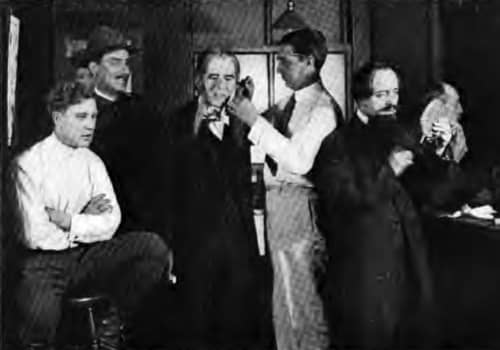
Above: 1916 Richard Leslie [c.1883-?] applying brand-up to extras on a Vitagraph fim set. He had been made Make-up Manager for Vitagraph five years earlier.
New film stocks
When the movie manufacture converted to panchromatic motion-picture show in the late 1920s the earlier make-up rules had to be abandoned. In Hollywood, the studios looked to specialists like Max Factor to help solve the make-up problems generated past the change in pic stock and the switch to incandescent lighting necessitated by the introduction of sound. The make-up developed for panchromatic film by Max Gene and others required screen players to change the mode they fabricated up for filming. By at present this was becoming increasingly controlled past studio make-up departments.
Meet besides: Panchromatic Brand-upwardly
First Posted: 17th February 2013
Terminal Update: 25th Feb 2021
Sources
Basten, F. E. (1995). Max Factor'south Hollywood. Glamour, movies, make-up. Los Angeles: General Publishing Group.
Bernique, J. (1916). Motion picture acting for professionals and amateurs a technical treatise on make-up, costumes and expression. Producers Service Company.
Bordwell, D. Staiger, J., & Thompson, K. (1985). The classical Hollywood cinema. Pic fashion & manner of production to 1960. New York: Columbia University Press.
Brownlow. One thousand. (1968). The parade's gone by. New York: University of California Press.
Brownlow. Chiliad. (1979). Hollywood: The pioneers. New York: Alfred A. Knopf.
Chalmers. H. (1925). The art of brand-up, for the stage, the screen, and social utilise. New York: D. Appleton and Company.
Clarkson, W. (1918). The art of screen brand-up. The Bioscope October, 24, p. 95.
Dangerfield, F., & Howard, N. (1921). How to become a picture show artiste. The art of photo-play acting. London: Odhams Press Ltd.
Dench, E. A. (1917). Motion movie instruction. Cincinnati: The Standard Publishing Visitor.
Eastman Kodak Co. (1919). The photography of colored objects (third ed.). Rochester, NY: Author.
Emerson, J., & Loos, A. (1921). Breaking into the movies. New York: James A. McCann company.
Gregory, C. L. (Ed.). (1920). A condensed form in motion movie photography. New York: New York Institute of Photography.
Handley, C. Due west. (1954). History of movement-picture studio lighting. In R. Fielding (Ed.). (1967). A technological history of motion pictures and television: An album from the pages of the journal of the society of motion picture and television engineers. (pp.120-124). Berkeley: University of California Press.
Hatton, R. (1922). Making upward for the screen. In Photoplay Research Society. Opportunities in the motion movie industry. Los Angeles: Author.
Lescarboura, A. C. (1921). Behind the motion motion picture screen (second ed.). New York: Scientific American Publishing Company.
Leslie, R. (1916). The art of make-up. Movement Motion picture Classic. October, 22-24.
Mees, C. E. Grand. (1954). History of professional person black-and-white movement-picture film. In R. Fielding (Ed.). (1967). A technological history of motion pictures and television: An anthology from the pages of the journal of the lodge of move pic and idiot box engineers. (pp. 125-128). Berkeley: University of California Printing.
Rathbun, J. B. (1914). Motion flick making and exhibiting. Chicago: Charles C. Thompson Visitor.
Redgrove, H. Due south., & Foan, M. A. (1930). Paint, powder and patches: A handbook of make-upwards for stage and carnival. London: William Heinemann.
Wagner, R. (1918). Film Folk. The Century Company.
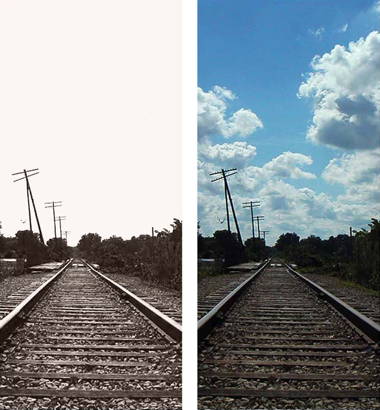
A representation of the departure between blue-sensitive film and modern colour motion picture. Note how the sky looks washed out and clouds do non show upwards. (Modified from an prototype created by Peter Patau).
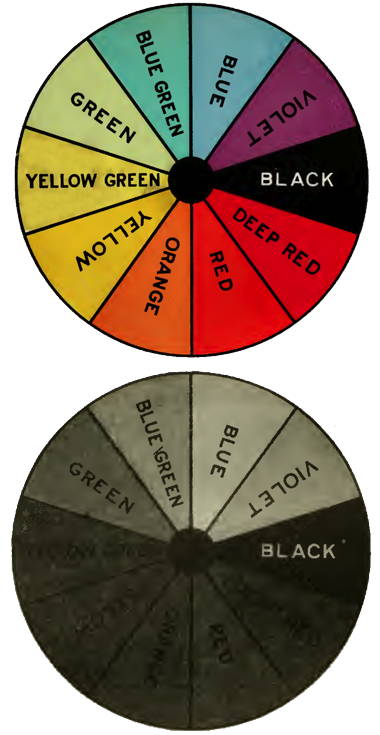
Colour charts to represent how blue-sensitive film registers colour in shades of gray (Modified from Eastman Kodak Co., 1919).
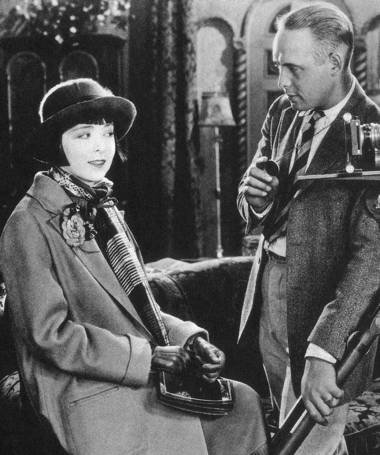
Cinematographer Joseph LaShelle [1900-1989] wearing a blue glass filter around his neck to assist him judge the tonal effect of colours. Cameramen frequently used some grade of blue glass filter to assist them approximate how blueish-sensitive motion-picture show would record a scene. When viewed through the drinking glass the scene was reduced almost to a monotone, and reds and greens appeared dark. In extreme cases it was not authentic, as blue-sensitive film is sensitive to ultra-violet lite which the man center cannot run across.
The actress is Colleen Moore, a.grand.a Kathleen Morrison, [1899-1988]. She had heterochromia (one brown and one blueish eye) and before she was given a studio contract a exam movie was made at Essanay Studios to see how they photographed on orthochromatic film. The examination revealed that her left and right heart looked slightly different on moving-picture show but information technology was not obvious so she was given a contract with Triangle-Fine Arts.
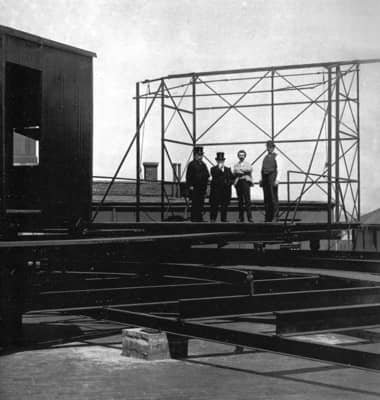
1896 American Mutoscope and Biograph Company erecting a rotating phase that can follow the sunday on the tiptop of the Hackett-Carhart Building in New York.
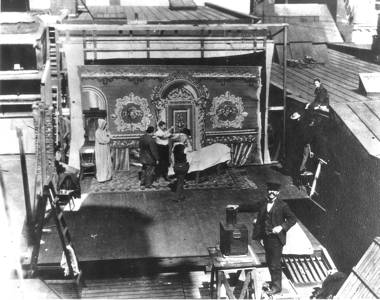
1899 A dressed, open up-air set on the roof of the Lubin Studio in Philadelphia. Shadows from surrounding buildings could bear witness to exist a problem.
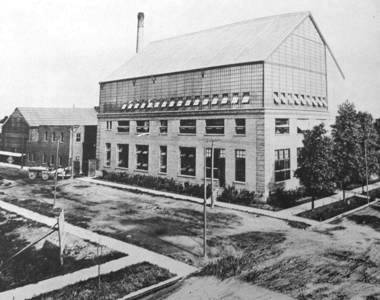
The Selig Polyscope Visitor in Chicago showing the 'glass house' on top of a building used to motion picture in daylight.
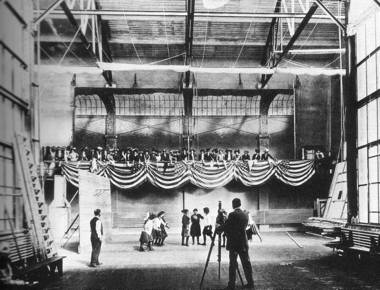
1908 Edison Studio using natural lighting controlled by screens.
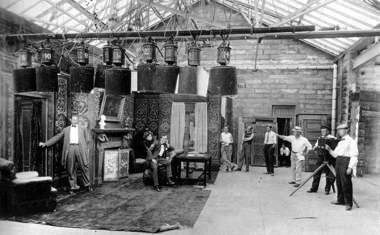
1910 Vitagraph motion picture studio using Aristo arc lights to supplement natural daylight. Lights this shut would have been extremely hot to work under.
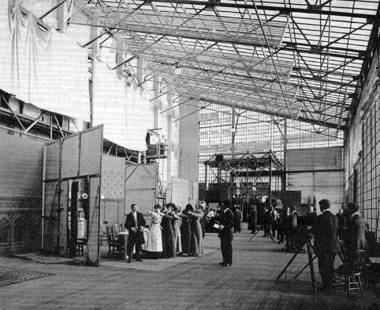
A Lubin Company film studio around 1911 using natural lite. As the films were silent a number of movies could be made along side each other.
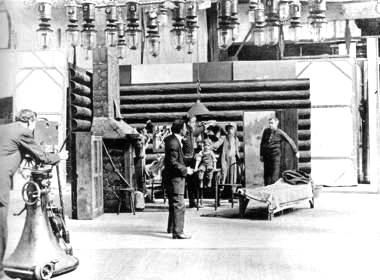
1911 Edison motion picture studio using overhead arc lights.
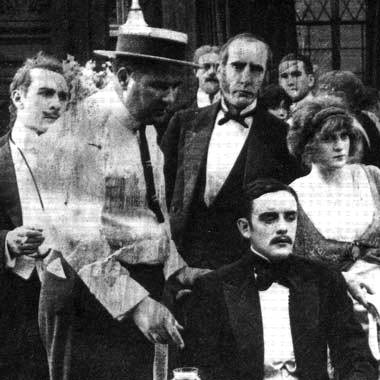
1912 Brand-up on a D. W. Griffith movie. Note the tonal differences betwixt the lead male histrion (seated heart), the technician in the straw boater chapeau (who is non wearing brand-up), and the other members of the cast.
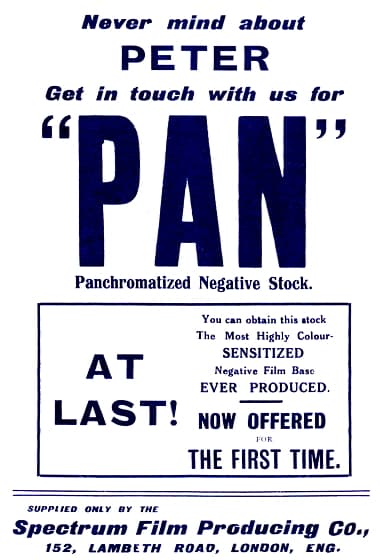
1913 Spectrum Film Producing Company, London. Panchromatic picture stocks were available in the 1910s just they were non widely used until the late 1920s.
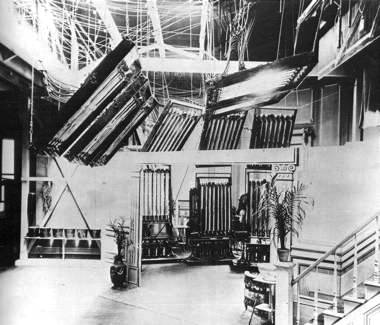
1914 Biograph film studio showing Cooper-Hewitt mercury-vapour lights. These lights were oft only a few feet away from the actors.
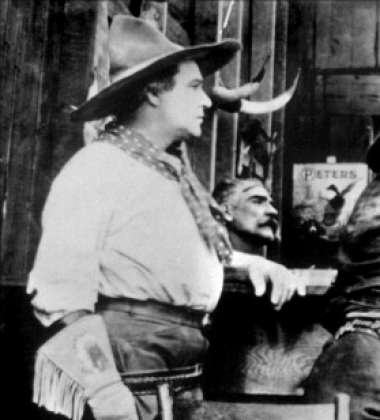
1914 The Squaw Homo. The divergence between a lead and an extra tin can be seen in this image. The brand-up worn past Dustin Farnum [1874-1929] (front) gives him a mask-like look. Grey-scale tonal differences were limited in blueish-sensitive film but Thompson has suggested that this impression is overstated because the one-time silent films we see were created from positive prints rather than from original negatives (Bordwell, Staiger & Thompson, 1985, p. 281). If this is correct then some of the mask-similar appearance of this lead actor would not have been every bit noticeable when the moving picture was originally screened.
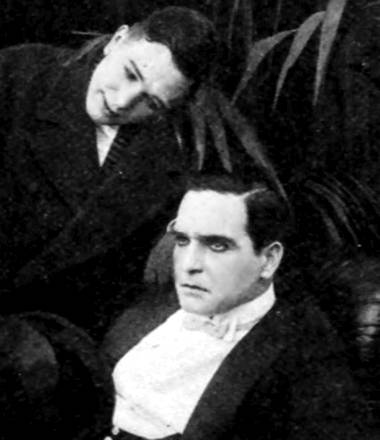
Earle Williams [1880-1927] in 'His Phantom Sweetheart' (Vitagraph, 1915) wearing a lot of eye make-up.
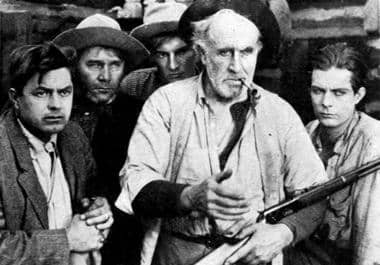
A range of make-up styles used by different actors in 'The Trail of the Lonesome Pine' (Laskey Photoplay Company, 1916).
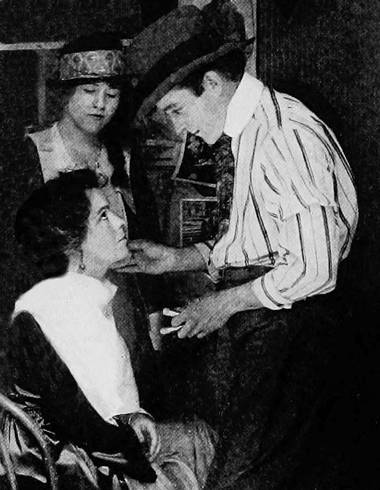
A make-up man using stick greasepaint at Universal Studios (Wagner, 1918).
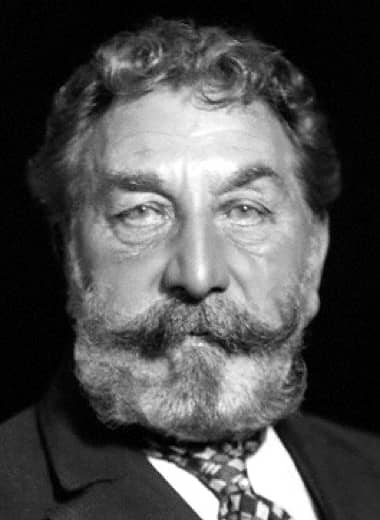
William 'Willy' Clarkson [1861-1934], a well-known London theatrical costumier and wigmaker discusses screen make-upwardly.
"In making upwardly for the camera information technology is essential to remember in the first identify that the weather condition to be considered are utterly dissimilar from, and in many respects opposed to, those of the theatre. The poor results obtained with make-up by artists in the early days of the screen play were entirely due to ignorance of this difference and neglect to submit the demands of the camera to a scientific analysis. The theory that it is impossible to employ make-up in acting for the camera is pure fallacy. Brand-up may exist used every bit extensively in the studio as on the phase, but it must be used differently and with fifty-fifty greater skill and precision.
One of the rudimentary necessities of making-upwards for the screen is the complete avoidance of carmine—in lips, in cheeks, in clothes—in fact, anywhere. Rouge or lip salve must never be employed; they produce a hideous negroid black. The usual tints for an ordinary directly make-upwards on the screen are v or 5½—that is to say, equivalent make-upwardly for a Chinaman on the stage. Grey should be used for lips in place of ruby-red and as well above the eyelids. Children are paled and sallowed because the salubrious, fresh complexion of a kid photographs a heavy black.
It must never exist forgotten that it is the effect as reproduced by the photographic camera, and not as seen by the man center, that is the test. Some producers, such as Mr. Thomas Bentley, insist upon reviewing the brand-upward of their artists through the lens of the camera before finally passing them. This method frequently reveals otherwise undiscernible faults of detail, such equally the gumming-up of a moustache, which may accept one-half an 60 minutes to adjust accurately.
Wigs for the screen differ from wigs for the phase inasmuch as the latter all have 'temples,' whereas in the former case the join, all the same carefully plastered, would always become visible on the picture show. Screen wigs are therefore always specially cutting, and never beetle across the natural pilus.
The ear is an important only oftentimes neglected detail, through which the whole character of the face may be accentuated or altered. Past colouring the lobe of the ear facial defects may be considerably modified—a betoken carefully studied by French actresses, including Sarah Bernhardt.
Many have wondered how the faithful representations on the screen of well-known historical personages accept been accomplished. Information technology is washed in the following way: A large company of competent actors are engaged on trial. These are studied past myself or my assistant. We cull the type of face which contains the essential features that cannot be wholly manufactured, merely which serve equally a basis for working upon. We then proceed to change and complete the minor features with paste, paint, and sometimes a false role, to secure the necessary likeness.
There is no doubt about it, British productions accept browbeaten American in the question of make-upwards and costume. The Americans rely upon broad furnishings and masses of players, simply hither nosotros take made personal advent a art. Yous may more often than not take it for granted that the costumes and settings employed in any menstruum picture by a recognised British company are historically authentic." (Clarkson, 1918, p. 95).
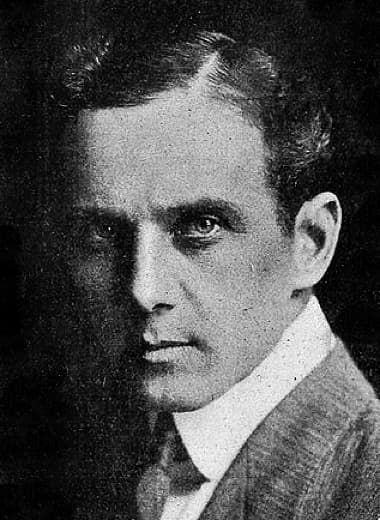
Frank Hall Crane [1873–1948] with his opinion on the best make-up for the screen.
"I have experimented with many dissimilar tones of grease paint and pulverization to get natural results on the screen, but have settled on 1½ paint and a calorie-free pink powder as the make-up most satisfactory for full general purposes. Many directors use this combination and concur with me that it cannot exist browbeaten. This make-up supplied by the producing company, should be used by the entire cast to get a general uniform effect. The paint should be of one brand and from one manufacturer, while the powder should be mixed in large quantities at the studio. I always mix information technology myself, using a heavy mortar and pestle to grind it as fine as possible. The make-up for both outside and and interior scenes should exist the same." ('The kinematograph weekly,' September 30, 1922, p. 57)
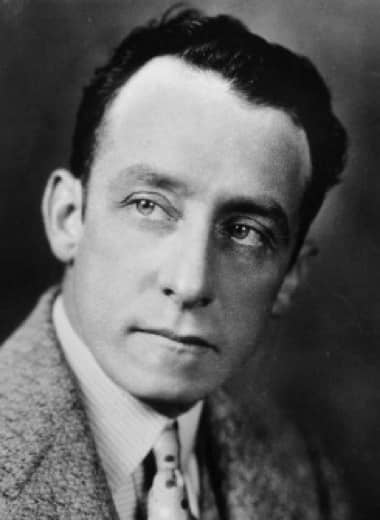
Raymond William Hatton [1887-1971], a graphic symbol actor, gives his views on applying make-up colours.
"For a straight grapheme I apply a number five, which I tin best describe as a rather light brownish-yellow.
… To a higher place my eyes, in straight brand-upward, I use a thin, smooth shading of brown. My eyelids are lined with the same color. Many players prefer black for the eyes and never vary from information technology, but it has been my experience that the brown gives a much softer screen tone which is far more desirable. This again is a thing of personal preference also as a affair that depends on the natural coloring of the individual, and there tin can be no set rule.
Many players, even the nigh experienced, I think, ruin what is otherwise a perfectly splendid brand-upwardly past using too heavy colour on the lips. My preference is for a rather lite scarlet and I employ an extremely thin coat of that. In fact, the grease on my lips does picayune more than accentuate the natural shape of the mouth. The resultant screen tone is a soft dark grayness, that suggests the existent color of one's lips much more accurately than the hideous blackness so often seen on the screen. The black, of class, comes from also heavy a glaze of too night a red and is something yous should be careful to avoid.
Last, and entirely every bit important every bit any other feature of the brand-up, is the powder. My pulverization is a shade that corresponds to the number five paint.
… More often than not speaking, women use lighter make-up than men. Mrs. Hatton uses a number 2 grease paint, which is nigh the average for women in straight make-up, although women must vary their shades of grease with type the same equally men. Mrs. Hatton has found after much experimenting that a blend of this number two grease paint with a number seven powder quite dark gives the best possible results. Her make-upwards for her rima oris and eyes is quite similar mine." (Hatton, 1922, pp. 22-24).
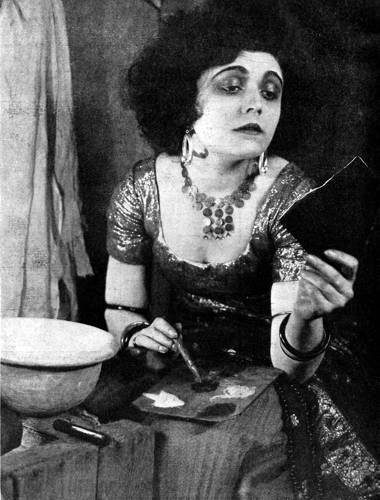
1922 Pola Negri [1897-1987] applying brand-up. She appears to be using a palette of four colours and applying them with a brush. In that location is a greasepaint stick next to the basin.
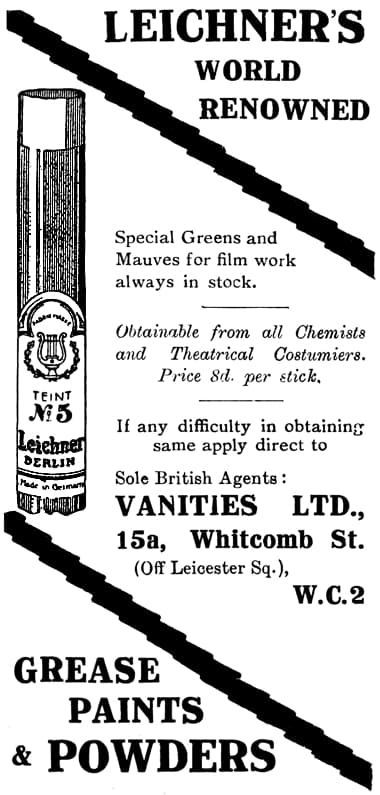
1922 Leichner Special Greens and Mauves for motion-picture show work (Great britain). Leichner referred to No. five (Chinese) equally its Principal Movie theater Shade.
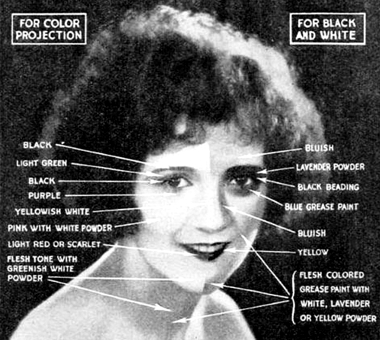
Make-up comparison showing how to make-upward for blackness and white and colour films. In that location were a number of experiments with colour motion-picture show systems through the early part of the twentieth century. Unfortunately, I do not know the type of colour film stock this make-upward was designed for. Given the make-up colours used for the black and white make-upwards it would appear that the suggested black and white make-up is for blue-sensitive or orthochromatic film.
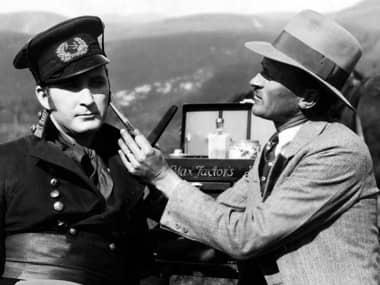
1927 Makeup artist Jack Dawn [1892-1961] trimming the sideburns of the player Tim McCoy [1891-1978] during the filming of California (MGM, 1927).
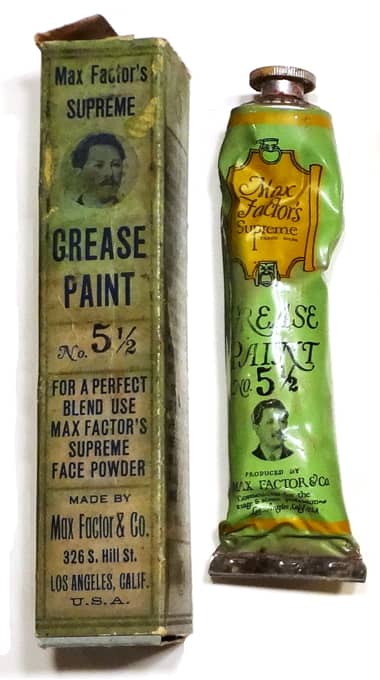
Max Factor'south Supreme Greasepaint packed in aseptic light-green tubes.
Source: https://www.cosmeticsandskin.com/cdc/early-movie.php
Posted by: bryantnorigoind1941.blogspot.com
0 Response to "What Makeup Used For Film Sets"
Post a Comment